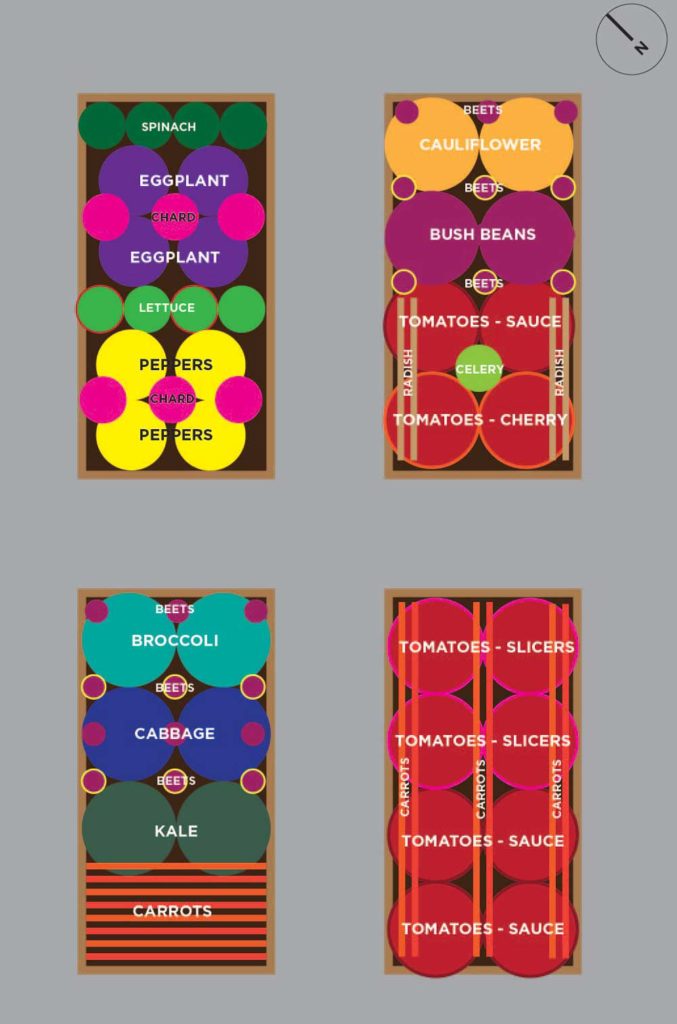
This year my vegetable gardening plans are bursting at the seams! I poured over seed catalogs this winter, put in a huge seed order from my favorite suppliers and spent way too much time planning out every plantable inch of our homestead. The result is this colorful diagram that shows what will grow where this season in our raised beds.
Our 2016 Vegetable Planting Plan (for raised beds that are each 4′ x 8′)
It’s important to take the time to layout your garden to scale. You could use trace paper, but I use Adobe Illustrator – an expensive graphics program that I use for my residential design work. Having a scaled drawing will make sure there is enough room in your beds for all the crops you want to grow. It also helps organize your crop rotation – the practice of moving crops to new locations each year to minimize nutrient loss in the soil and reduce plant diseases.
Juniper with some of her favorite veggies: a small bucket of cherry tomatoes and freshly pulled carrots
This year I increased the number of Juniper’s favorite crops, like cherry tomatoes and broccoli. I also increased the number of low-protein vegetables to accommodate River’s PKU diet, like carrots, eggplants and cauliflower. I am maintaining a good number of sauce tomatoes and interesting heirlooms. We rely heavily on canning those crops to get us through winter.
Companion-planting crops will help me maximize my garden space. Carrots and radishes don’t need much space above ground, so those will be planted between the tomatoes that take up lots of above-ground space.
Bolting spinach gets pulled right when the warm-season peppers and eggplants will go in.
Cool season crops are timed to come out when warm season crops take their place. Lettuce and spinach may seem crowded in between the peppers and eggplants, but those greens are for the cool season. They will be pull before the larger eggplants and peppers go in. I will replant the greens in late summer when the shade from the tall peppers and eggplants can keep them from bolting.
I didn’t decrease any plantings, but rather moved them to better places in the garden. The onions are getting planted along plant bed edges, along with my regular shallots and garlic. Additional broccoli plants will get tucked into sunny pockets between our existing blueberry plants.
Sprawling crops like winter squash grows under our fruit trees among berry bushes and strawberry groundcover
Sprawling plants like summer squash, winter squash, potatoes, cucumbers and pole beans all get planted throughout the garden. They climb up Juniper’s teepee or snake along the ground under our fruit trees. I’ll amend the soil where they are planted to give them a nutrient boost, since they don’t have access to the good soil I imported into our raised beds.
This might be my most ambitious year yet! More and more of our edible trees, shrubs and groundcovers will produce fruit this season. And I’m already planning how we’ll preserve the vegetable crops to get us further through next winter.
Interested in what I’ve planted in past years? Here is a list of older vegetable garden plans:
Do you typically layout a garden plan before you plant? Why or why not? How is your garden plan this year evolving over years past? Tell me about it in the comments below!
Want help with your own garden? I’m a landscape architect, and I design residential gardens in Portland: edible landscapes, native plantings and outdoor spaces that pull you outside. See my work at Renee Wilkinson Landscapes.
We are going more ambitious than ever also! Our new homestead is more than double our former space in Columbus. We went from .20 acre to .40 acre, which is on a double lot. The lot with our home is the main “production” area. We have an entire back yard directly behind the house slotted for raised beds and rows (which my husband is using a broadfork to dig – bless his heart!). The perimeters of both lots will contain our fruit trees and bushes (blueberries, raspberries, grapes, pears, peaches, elderberries, and heirloom apples that we ordered from Seed Savers that will arrive Spring 2017). The second lot is mainly for the compost bin and we are looking into either hives and/or chickens. Our only concern with livestock is making arrangements when we want to travel for a week or so. Even with livestock, our daughter still has plenty of room to play in the second yard. The second lot also contains a maple tree for shade, and perhaps we will look into tapping it next year. I really enjoy reading your activities, and I usually read through your book once a year. They are both very inspirational and provide new ideas!!!
I generally follow Portland Nursery’s veggie planting calendar (https://portlandnursery.com/docs/veggies/VeggieCalendar.pdf). I use homemade compost and organic fertilizer, such as Down To Earth All Purpose 4-6-2 and add at planting and about once a month through the warm season.

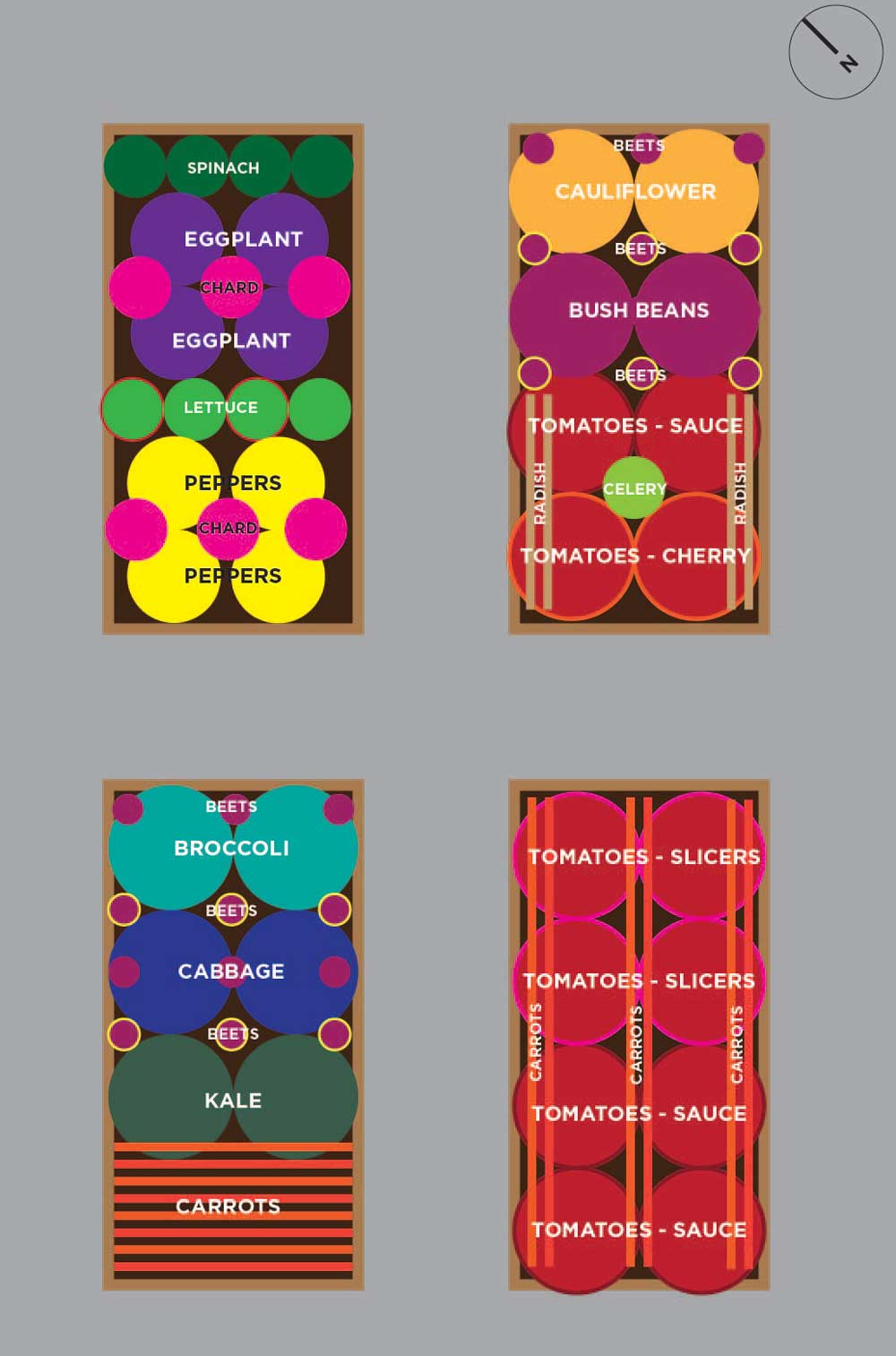


RT @hipchickdigs: 2016 Vegetable Garden Plan: What and where we are planting our veggies this year https://t.co/ZUFsloLxdQ
#agchat #urbanag 2016 Vegetable Garden Plan https://t.co/PCFJj9eToz /by @HipChickDigs
Pingback: Seed Starting Calendar | Hip Chick Digs
We are going more ambitious than ever also! Our new homestead is more than double our former space in Columbus. We went from .20 acre to .40 acre, which is on a double lot. The lot with our home is the main “production” area. We have an entire back yard directly behind the house slotted for raised beds and rows (which my husband is using a broadfork to dig – bless his heart!). The perimeters of both lots will contain our fruit trees and bushes (blueberries, raspberries, grapes, pears, peaches, elderberries, and heirloom apples that we ordered from Seed Savers that will arrive Spring 2017). The second lot is mainly for the compost bin and we are looking into either hives and/or chickens. Our only concern with livestock is making arrangements when we want to travel for a week or so. Even with livestock, our daughter still has plenty of room to play in the second yard. The second lot also contains a maple tree for shade, and perhaps we will look into tapping it next year. I really enjoy reading your activities, and I usually read through your book once a year. They are both very inspirational and provide new ideas!!!
Pingback: Planning Blog
Pingback: 19 Vegetable Garden Plans & Layout Ideas That Will Inspire You
Pingback: 12 Vegetable Garden Plans & Layout Ideas That Will Inspire You – Gardening Cosmo
Pingback: 10 Vegetable Garden Plans & Layout Ideas That Will Inspire You – Gardening Cosmo
Pingback: 12 Vegetable Garden Plans & Layout Ideas That Will Inspire You – Gardenisti
Pingback: 19 Vegetable Garden Plans & Layout Ideas That Will Inspire You - Bienvenue
Pingback: 19 Creative Vegetable Garden Ideas – Get DIY Idea
I LOVE the way you create your layouts! How do you decide how big to make each shape?
It’s to scale, so I made each circle size based on the plant’s mature size. Hope that helps!
When do you plant each one and when do you pull them to plant the next? What additives, fertilizers, etc. do you add and when?
I generally follow Portland Nursery’s veggie planting calendar (https://portlandnursery.com/docs/veggies/VeggieCalendar.pdf). I use homemade compost and organic fertilizer, such as Down To Earth All Purpose 4-6-2 and add at planting and about once a month through the warm season.
Pingback: 19 Vegetable Garden Plans & Layout Ideas That Will Inspire You - Homesteading Alliance
I did a 12 role of mixe vegetable