


Salal is one of those Northwest natives that I have often heard people talk, but have never been familiar with it myself. In my Plants class this term, we are studying evergreen trees, shrubs and ground covers. We learned all about Salal this week and it is really a fantastic problem-solver in the garden.
The botanical name for this plant is Gaultheria shallon, which is commonly called Salal. This is a broad leaf evergreen ground cover native from Alaska down to California, which hints at the broad zoning range of the plant. It is hardy in Zones 4-7.

Let me explain why this little plant is so awesome. Do you have a pine tree or evergreen tree growing in your yard or a friend’s yard? It’s always so hard to figure out what exactly to grow under there, with all that acidic needle drop. Enter Salal.
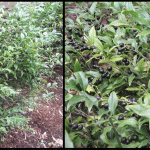
Salal loves acidic soil – in fact it prefers it. It also loves deep shade or partial shade. The evergreen leaves are attached to red stems. The topside of the leaves have a reddish hue and green undersides. Because this is evergreen, you get something pretty to look at all year round. It is also deer resistant!

(Photo from One Green World catalog)
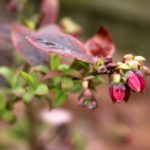
But wait – the plot thickens. Come Springtime, this little guy shows off pink-white hanging urn-shaped flowers that later turn into purple berries in the Summer. Native Americans would gather these berries and eat them as a syrup or dried into cakes.

The plant ranges in 2′-4′ in height, although I have seen numbers higher and lower. It can spread above ground up to 20′ in width. It also spreads underground with runners, but is not aggressive enough to be considered a pest. To plant a thick blanket of ground cover, space the plants 3′ apart during planting.
Isn’t this a great plant? Evergreen fat leaves, beautiful foliage and stems, loves acidic soil, loves deep share, flowers in the Spring, edible fruit in the Summer, deer-resistant, and a native plant! Go forth and plant Salal!



That certainly does sound like a versatile and lovely plant. The deer resistance is especially appealing, especially for suburban landscapers. I assume that the edible berries are good for fostering bird habitat.
Fabulous post! I grew up in Bandon and Salal is great over there. Here in the Rogue Valley it is not a real happy plant. We are a bit to dry and hot but just head up the valley to the higher elevations and it is happy again 🙂
great to hear – a nice alternative in my shady areas to ferns 🙂
It is a useful and beautiful plant – a great replacement for english ivy under the trees in our NW gardens.
But be warned, once you put it in it can take over and it’s very hard to “control.” Salal edges my lawn and there are constantly shoots coming up a few feet in. I can’t stop it!
But the berries are lovely and it sure was nice to see green leaves peeking out of the crazy snow we had recently.
Do bears like the fruit/berries on this Salal plant?
What an interesting question. I have no idea!
I have a floral bouquet that was given to me that has Gaultheria shallon in it and the stems have started sprouting new leaves and flowers. Is there any way you think I could get it to root and plant it?
You could try! I would dip the ends in rooting hormone and plant up in potting soil (not just soil from your garden). Good luck and let me know how it goes!
is salal deer resistant? what bushes are deer resistant
Yes, I have heard it is deer resistant.
The article says to plant salal 3′ apart. Is that true regardless of size (2″ pot, 4″ pot, 1 gallon container)? We have several 2″ pots and I am trying to find how closely to space them.
Plant spacing depends on how quickly you want the area to look filled in. Salal can spread 6′ or more once mature. If you are planting from small 4″ containers, you could space them 18-24″ and the area will fill in faster.
Agh! nobody should be advised to grow Salal. it will choke out any other plant with roots shallower than 2 feet. The very thought just gives me chills. Save yourself and your garden while you can.
Mous, I hear you – it will take over. But it’s also native and can be a good solution in the right context. For example, if you have a large slope or a forested area of your property that needs coverage. In a small garden, yes it will outcompete other things.
I live in zone 8B and my property is covered in salal. I don’t mind the wildness on the fringes of the property, but am going for a more managed and manicured look for the rest of the property. I had the salal removed from a large bed (tree island) in the beginning of summer, but it is coming back. I will have it removed again in the spring, but would like to plant something like a groundcover that is low growing and flowering. Is there anything that fits that bill that would also overtake and crowd out the salal, or will the salal return and overtake any new plants? I’ve got cherry trees, rhodies, sweet tea olive, and gardenia plants currently and want to add a couple of other flowering shrubs. I have liriope and blue fescue planted along the brick retaining wall. Looking for low maintenance color and scents in the garden. Am considering various types of mint as ground cover.
Salal can definitely take over. I usually recommend clients delineate some kind of invisible “line” (like an area of shrubs) + keep it maintained/cut back up to that line. For the area you don’t want salal, there aren’t great options for low + flowering groundcovers that are native. But there are lots to choose from that are non-native depending on sun/shade: Ajuga repens, winter heaths + heathers, Ceanothus (there are some low groundcover varieties), Pachysandra, Rubus calycinoides, and others.